
Under the distinguished patronage of Alderman Geordin Hill-Lewis, Mayor of the City of Cape Town
Oom Paultjie’s Two Veldponde
Pierre H. Nortje (November 2025)
Earlier this year, the author was contacted by a member of the Western Cape Numismatic Society, Anthony Govender, who requested an English translation of three old handwritten letters dating from 1939 that were written in Afrikaans.

Source: Anthony Govender
The matter involves Mr. P.R. de Villiers (“Oom” Paultjie de Villiers, who was acting Treasurer-General during the Anglo-Boer War and one of the two signatories of the emergency Pietersburg Goewerments Notes), who apparently gave General C.H. Muller a rimmed and rimless gold pond and asked him to have them stamped with the Veldpond dies at Pilgrim’s Rest. (The blank ponde were ordinary Kruger ponde that had not yet been struck, i.e., blanks). After the war, Mint Master P.J. Kloppers visited De Villiers in Stellenbosch and, after studying the two coins, said that they were ordinary Veldponde.

Picture above of a Veldpond and below the two varieties of the Kaal (blank) pond (Source: WCNS).
However, De Villiers disagreed and said that the two coins were the last 2 Veldponde struck, and because the blanks were kaalponde (blanks) and not Veldponde, the dies broke (gebars = cracked) because the gold was harder than the Veldpond gold. Kloppers vehemently denied that there was anything wrong with the dies after he gave them to General Muller after the Field Mint was closed.
This whole matter is discussed in detail in Matthy Esterhuysen’s book “Ons Gelderfenis”, published in 1980, on pages 43-46.
Esterhuysen tells us that the National Cultural History and Open-Air Museum in Pretoria (currently named the Ditsong National Museum of Cultural History) possesses these Veldponde, which are said to be unique, together with two documents that certify their authenticity. The two Veldponde were presented as a gift to the Union of South Africa in 1949 by P.R. de Villiers, former acting Treasurer-General of the South African Republic during the Anglo-Boer War.
De Villiers claimed that the two coins were unique, as they were struck on two blank ponde. His brother, Arthur van der Linde de Villiers, a bookkeeper to the Treasurer-General, received a few bags of blank ponde at Machadodorp (currently named eNtokozweni) to pay for war expenses.

The signature of P.R. de Villiers on an emergency banknote of the ZAR dated Pietersburg, 1 April 1901. (Source: CGB-numismatics France).
To distinguish the two variations, the officials named them “Doppie” and “Plaatjie”, the former because the coin had a rim, and the latter because it was rimless. Although Esterhuyse did not mention it, the two varieties were also sometimes called the Machadodorp (rimmed) and Lydenburg (rimless) issues.
She says that General C.H. Muller authorised De Villiers to take charge of the “Munt Te Velde” (Field Mint) at Pilgrim’s Rest. When he was called to attend the national assembly for peace talks at Vereeniging towards the end of the war, De Villiers appointed Field Cornet Andrew Pienaar in his place. During the meeting, General Muller received a “Doppie” and “Plaatjie” from De Villiers, who requested that they be stamped for him at the Munt Te Velde. After the two coins were struck, they were given back to De Villiers.
After the Boer War, he sold one coin to his brother-in-law, Mr. Jannie Marais of Stellenbosch, for 25 Guineas. After Mr. Marais’ death in 1915, his widow, Mrs Elizabeth Johanna Hendriecka Marais (nee de Villiers), was the legal owner of the coin. She and her brother, “Oom Paultjie”, decided to donate the two unique ponde to the Pretoria Museum.
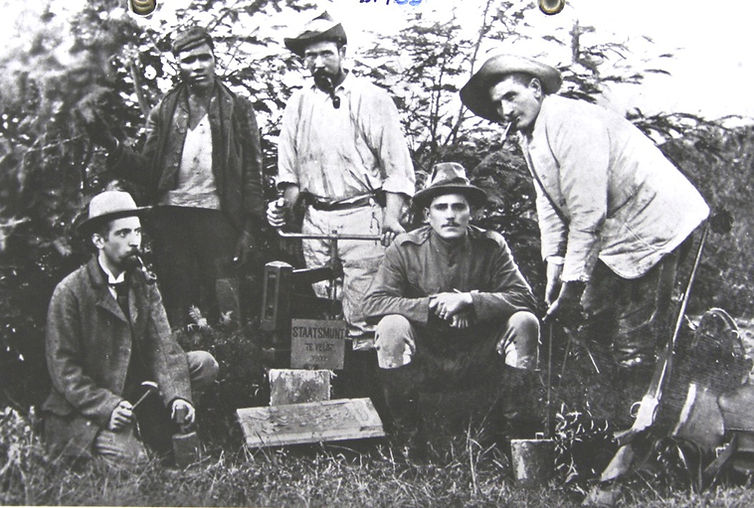
Munt Te Velde: Source: WCNS
After the war, Mint Master Kloppers visited De Villiers in Stellenbosch and, after thoroughly studying the two coins, said that they were ordinary Veldponde. However, De Villiers said that they were the last two coins struck with the Veldpond dies, and because the gold with which blank ponde were struck was harder than that with which the Veldponde were struck, the dies cracked. Mr. Kloppers denied that the dies were cracked when he handed them over to Gen. Muller after the closing of the Mint. He was also unaware of a request made to him to strike blank ponde with his dies.

Left to right: P.J. Kloppers, Field Cornet A.G.E. Pienaar and General C.H. Muller. According to a study by Dr. Rentia Landman-Reid (2013) … “Kloppers was not the Head of the Field Mint as he claimed. It was in fact Field Cornet A.G.E. Pienaar”.
Kloppers also noted that the Veldpond and the Blank Pond were of different sizes, and therefore, the Blank Pond, which had a smaller diameter and was also thicker than the Veldpond, could not be struck with his dies. (Author’s note: According to Herns’s Handbook on South African Coins and Patterns [2023:15], the rimmed pond is 21.65 mm in diameter, whilst the rimless pond is 22.16mm vs. the Veldpond’s +- 22.8mm. Both the blank ponde weigh 7.988 grams each, whilst the Veldpond weight can vary from 7.7306 grams to 8.5082 grams.)
Kloppers also established that the certificate of authenticity was written by De Villiers himself and signed by Gen. Muller. The content was described to Muller, who signed it in good faith. Mr. de Villiers, however, refused to accept Mr. Kloppers’ findings and claimed that he could not believe that he would be deceived by a trustworthy person.
Mr. Kloppers strongly insisted that the matter should be made public because his honour was at stake. His dies never cracked, and under no circumstances did any irregularity occur at the Munt Te Velde.
A final note
In terms of what Esterhuyse wrote, the two coins must still be in possession of the Ditsong museum in Pretoria with the two certificates of authenticity.