
Under the distinguished patronage of Alderman Geordin Hill-Lewis, Mayor of the City of Cape Town
Would the real Jan van Riebeeck please stand up?
Pierre H. Nortje (April 2026)
Introduction
In 1652, Jan van Riebeeck was sent by the United East India Company to the Cape of Good Hope to establish a way-station to provide food, water, and repairs to their ships. He arrived at the Cape on 6 April 1652, accompanied by 82 men and 8 women, including his wife Maria de la Queillerie. He served as the commander of the colony until 1662, after which he left for Batavia in the Dutch East Indies, where he died in 1677.
Use of Van Riebeeck’s image on South African coins, notes, medallions and stamps
What was then believed to be Jan van Riebeeck’s image was first used on a South African one-pound banknote in 1925. Sixty-five years later, in 1990, his image was depicted for the last time on our banknotes when it was thereafter replaced by images of the so-called “Big Five” animals.

When South Africa became a Republic in 1961, it was already decided that with the decimalisation of our coinage (Rands and cents) in that year, the image of Van Riebeeck would replace that of Queen Elizabeth II of Great Britain. In 1965, the second decimal coin series was introduced, and a profile picture of Van Riebeeck was used on some of the denominations until 1969, when its depiction on our coinage was finally phased out.

During the 1952 Van Riebeeck tercentenary, stamps showing the effigy of Jan van Riebeeck were issued by both South Africa and the Netherlands.

During the 1952 celebrations, various commemorative medallions were also struck. By that time, South Africans were used to seeing the familiar face of Van Riebeeck with his drooping black moustache, so it must have come as a surprise to them when one of the medals depicted a person they did not recognise. The enlarged picture below on the right shows this medal that was struck in the Netherlands by the Stol medal factory in Culemborg, Netherlands. As we shall see in this paper, this effigy of Jan Van Riebeeck and the more familiar one were based on two different paintings that was done in the 17th century during Van Riebeeck’s lifetime.

First portrait studies of Van Riebeeck
According to the late Prof. HB Thom, who was a former Rector of the University of Stellenbosch and editor of Jan van Riebeeck’s Dagregister (Journal), there were three portraits for which the claim had been advanced that they were portraits of Jan van Riebeeck. They were the following: -
-
The so-called “Town House” portrait, which hangs (or used to hang?) in the City Hall at Cape Town.
-
The portrait that is thought to have been done by the 17th-century Dutch artist, Dirk Craey, and used to hang in the Rijksmuseum in Amsterdam.
-
The “Batavia” portrait.
We used predominantly two sources for the following descriptions of the three portraits, the first being an article by Dr. F.W. F. Purcell entitled “Jan van Riebeeck’s Portrait” that was published on 5 April 1952 in the S.A. Tydskrif vir Geneeskunde (pages 297-299). The second was by Otto Peetoom entitled “The Riddle of Jan van Riebeeck …” that was published online on the South African Philatelic Forum on 28 December 2017.
The “Town House” portrait in the Cape Town City Hall

The ‘Town House’ picture, showing Van Riebeeck wearing a hat, is supposed to have been painted at the Cape in about 1660 by an unknown artist. The first mention of it is in a diary kept by Johan van Riebeeck’s granddaughter, who visited the Cape in 1710. It was then in the possession of a Hollander. Van Riebeeck’s granddaughter described it as having already gone very dark. In 1804, it was officially ‘discovered’ and presented to the Town. It was generally accepted as a true portrait until 1884, when the publication of the Craey portrait caused it to fall from favour. ‘It may be any other Governor’, said Mr H.V.C. Leibrandt, former Keeper of the Colonial Archives in 1892. Later research by Sir Percival David has made it seem more probable that it was originally a portrait of Van Riebeeck. But this research has also shown that the portrait has been modified and ‘improved’.
The portrait thought to be done by the 17th century Dutch artist, Dirk (also spelled Dirck) Craey
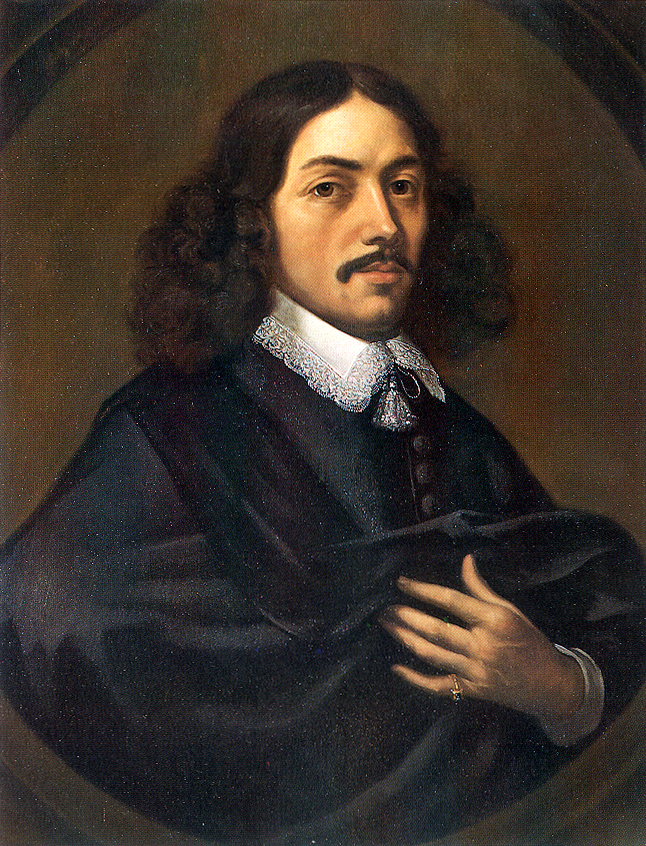
The Craey portrait is supposed to have been painted in 1650, two years before Van Riebeeck arrived at the Cape of Good Hope. Godee Molsbergen has said of it: “It has been over-painted so heavily that the Director of the Rijksmuseum is not certain if it is an original piece. In its present state it shows few, if any, brush strokes from Craey’s hand”. This picture has since been removed from the Rijksmuseum.
According to Dr. Purcell, his father, Dr. W. F. Purcell, noted in 1911 a meeting that he had with the Director of the Rijksmuseum, Mr. van Riemsdijk. The Director told him that the Craey pictures were part of a set of family portraits given to the Museum by a connection of the family, Mr. J. H. F. K. van Swinderen, in 1884. (Van Molsbergen suggested that the Craey pictures did not belong to this set but that the Batavian picture did).
Dr. W. F. Purcell describes how the portraits were taken from the walls, and the backs carefully examined for inscriptions. On the back of each was an inscription thought to be of a later period.
One was “Maria de Quellerij of Quevellerius, Huisvr. van Johan van Riebeeck, geb. 28 Oct. 1609, gest. 2 Nov. 1661”. In the corner of the picture was a shield with three circles. The picture was signed “1650 D. Craey”.
The other was labelled “Johan van Riebeek Antoniez . . . 1650 ges. 1677'.
The writing was very indistinct but could be made out clearly when it was held in a suitable light. The younger Purcell says that he can remember being present with his father at the time.
He says that the inscriptions on the Craey van Riebeeck were not visible in 1952 when he was shown the portrait by the Assistant Curator of the Rijksmuseum, Dr. R. van Luttervelt, in Cape Town. Dr. R. van Luttervelt informed him that the Craey picture was now thought to be an authentic likeness, but that the Batavian portrait was a doubtful likeness. Purcell noted that this is a complete reversal of van Molsbergen's opinion and that X-rays have shown that the Craey portrait of van Riebeeck is not heavily over-painted as van Molsbergen suggested.
Dr. van Luttervelt told him that recent research has shown that it was quite possible that the Craey picture was a contemporary portrait of van Riebeeck painted while van Riebeeck was in Schiedam, the home of Maria de la Quellerie. They were betrothed at Schiedam on 11 March 1649 and were married soon after. This was just before van Riebeeck came to South Africa.
Some sources are of the opinion that the Craey portrait is that of Bartholomew Vermuyden, a Dutch officer who had a senior role in the Parliamentary army during the English Civil War.
The “Batavia”’ portrait.

The Batavia portrait, which has been accepted by Prof. Thom as authentic, was one of a large collection of family portraits that was presented to the Rijksmuseum by a descendant of Van Riebeeck in 1884. The then Director of the Rijksmuseum of Amsterdam said there was ‘not the least reason to doubt its authenticity’.
According to Dr. F.W. F. Purcell, all portraits of Jan van Riebeeck have at some time or other been suspected of not being genuine likenesses of the first Commander of the Cape. Godee van Molsbergen, in his book on Van Riebeeck, De Stichter van Hollands Zuid-Afrika, preferred the so-called 'Batavian' portrait thought to have been painted in Batavia. Among his reasons were “ …that this picture bore the van Riebeeck crest in the upper left corner, and a landscape on the right side which suggested Table Mountain”. (Purcell says that an examination of the original picture shows how far-fetched the last suggestion is.)
Van Molsbergen stated that the Craey picture was heavily over-painted, and that the then Director of the Rijksmuseum, Mr. B. W. F. van Riemnsdijk, was not certain that it was an original portrait. The Cape Times of 19 May 1951 published an interview with Dr. H. B. Thorn, editor of the new edition of van Riebeeck's Diary, saying that he accepted van Molsbergen's conclusions, and was not going to make use of the Craey portrait. This was certainly surprising news as the engraving of van Riebeeck on the South African banknotes is based on the Craey portrait, being taken from the Veth copies made in the 1890s.
Later portraits and paintings
In 1851, Charles Davidson Bell, who arrived 20 years earlier from Scotland at the Cape, won a gold medal for his painting titled “The Landing of van Riebeeck at the Cape of Good Hope in 1652”, now held in the SA Library, Cape Town.

In 1897, the librarian of the Cape Parliament expressed a wish to Mr. William Frederick Hertzog of Bergvliet, Constantia, that an empty space in the library above the door to the librarian's room might be filled by a portrait in oils of Jan van Riebeeck. Mr. Hertzog at once agreed to bear the expense of such a portrait, and commissioned Jan Veth of Bussum, near Amsterdam, to paint 2 portraits of Jan van Riebeeck, and one of his first wife, Maria de la Quellerie.
According to F. W. F. Purcell (1952: 297-199) “The portrait of van Riebeeck was accepted by Parliament in 1898, and is at present in the library. The second picture of van Riebeeck is the one reproduced and is now in my possession. The portrait of Maria de la Quellerie was bequeathed by my mother, Mrs. Anna Purcell, to the Houses of Parliament, and when last seen was in the basement of the library. Jan Veth based his portraits-they are not exact copies – on those in the Rijksmuseum painted by Dirk Craey in 1650”.

Conclusion
We will probably never know which of the original three portraits truly depicts Jan van Riebeeck. For an art novice, the author feels that there is a likeness between the Town House and the Craey portraits, while the Batavia portrait shows a considerably older man. The Craey portrait was apparently painted in 1650, when Van Riebeeck was still a young man of 31 years. The Town House painting seems to portray a similarly looking man, slightly older, say in his late 30s or early 40s. We know that Van Riebeeck left the Cape when he was 43 and died in 1677 at the age of 58 in Batavia, where the third portrait was supposedly done of him. So theoretically, the Batavian portrait could have been painted when he was almost twice as old as when the first Craey portrait was done. Is there a chance that all three paintings actually depict the same man?