
Under the distinguished patronage of Alderman Geordin Hill-Lewis, Mayor of the City of Cape Town
Early Tin Pin Badges of South Africa
Pierre H. Nortje (August 2026)
A tin pin badge, also commonly known as a pin-back button, button badge, or "tinnie,” is a lightweight, circular badge made of a tin-plated metal shell. It features a printed design covered with a glossy protective film and has a built-in safety pin or clasp on the back to fasten it to clothing. These badges are widely used as affordable, everyday accessories, collectibles, and promotional items.
In 1892, Benjamin S. Whitehead and Chester R. Hoag founded the Whitehead & Hoag Company in Newark, New Jersey, United States. The company was to become the preeminent American manufacturer of advertising novelties and campaign buttons.
The next year, they patented their innovation of inserting a sheet of transparent film made of celluloid over a photograph mounted on a badge to protect the image from scratches and abrasion. A follow-up patent was for a metal pin to be anchored to the back of the button to fasten the badge to the lapel of a coat.

Sources: Picture left, Hake's Auctions. Picture right, datamp.org/patents
The company prides itself on being free from affiliation, bias, or influence regarding any persons, political parties, financial institutions, and businesses. This is evident with the outbreak of the Anglo-Boer War in 1899 when Whitehead & Hoag manufactured pin badges for both British and Boer sympathizers.

Sources: antiquarianauctions.com, newarksattic.blog and worthpoint.com
It is not clear how the patent legislation worked at the time, but other American companies like Baldwin & Gleason of New York, M.C. Lilley of Columbus, Ohio, and W.F. Miller & Co of New York manufactured very similar pin badges during the Boer War. In Hern’s Handbook on Medallions of the Zuid-Afrikaansche Republic and the Anglo-Boer War, he lists various pin badges made by Baldwin & Gleason of New York showing famous British generals like Roberts, Kitchener, Buller, Macdonald and White.

Exactly how many different Boer War related tin badges were manufactured is unknown, but looking at the following collection, it must have been quite a large number.

Source: Angloboerwar.com
Various badges of Boer leaders, especially Paul Kruger, exist, but whether they were all made during the Boer War (1899-1902) is not known. Some could have been made for his presidential campaign in 1898, while others could date from his period in exile in Europe or even after his death in 1904. In the picture below, the badge at the bottom right clearly postdates the Boer War.

After the end of the Boer War, the themes depicted on tin badges became more widespread in South Africa, but remained mainly politically motivated, either centring on political leaders or nationalistic events like the Great Trek Centenary of 1938, the inauguration of the Voortrekker Monument in 1949, and the Jan van Riebeeck tercentenary in 1952. From the 1960s onwards, tin badges became more advertising-oriented, especially in the music and pop industry when record labels and bands began using them as promotional items. (This and later eras are not covered in this paper).
Political and military figures (Up to the 1950s, the following persons – Boer War British soldiers excluded - were depicted on tin badges, and in some instances, more than one portrait of the person is known. We only show one example of each below.)
Person
Comments
Example
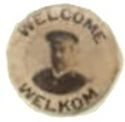
Botha, Louis
General Louis Botha was an Afrikaner soldier and statesman who served as the first Prime Minister of the Union of South Africa. We speculate that the badge was made to welcome him back from Europe in late August 1919, just days before his death. However, we are not 100% sure if it is indeed he depicted on the badge.
De La Rey, Koos
Koos de la Rey was a South African military officer and served as a Boer general during the Second Boer War of 1899 to 1902.

De Wet, Christiaan
Christiaan de Wet was Commander-in-Chief of the Free State forces during the Anglo Boer War.

Du Plessis, W.C.
The picture is not clear but we think this is “Wennie” du Plessis who made history during the 1948 election when, as a National Party candidate, he won the Standerton constituency from the then Prime Minister, Gen. Jan Smuts of the United Party.

Fourie, Jopie
Josef Johannes Fourie was a Boer soldier who later took part in the Maritz Rebellion of 1914–1915 against General Louis Botha. For his involvement, he was found guilty of treason and executed by firing squad.

Griffith, Seeiso
Simon Seeiso Griffith was the paramount chief of Basutoland from 23 June 1939 until his death in December the following year.

Havenga, Nicolaas Christiaan
“Klasie” Havenga was a South African politician who served as Finance Minister in the governments of J. B. M. Hertzog and D. F. Malan.

Hertzog, Barry
J. B. M. Hertzog, was a South African general and politician. He was a Boer commander during the Second Boer War and served as the third prime minister of the Union of South Africa from 1924 to 1939.

Joubert, Piet
Piet Joubert served as the commandant–general of the South African Republic from 1880 to 1900.

Malan, D.F.
Daniel Francois Malan was a South African politician who served as the fourth prime minister of South Africa from 1948 to 1954.

Pretorius, M.W.
Marthinus Wessel Pretorius was a South African political leader who helped to establish the South African Republic and was the first president of the ZAR.

Strauss, J.G.N.
Koos Strauss was a South African politician who succeeded Jan Smuts as leader of the United Party in 1950.

Smuts, Jan
General Jan Christiaan Smuts was a military commander and served as Prime Minister from 1919 to 1924 and again from 1939 to 1948.

Steyn, M.T.
Marthinus Theunis Steyn was a South African statesman. He was the sixth and last president of the independent Orange Free State from 1896 to 1902.

Strydom, J.G.
Hans Strydom was a South African politician who served as the fifth prime minister of South Africa from 1954 until his death in 1958

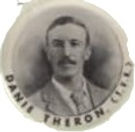
Theron, Danie
Captain Daniël Johannes Stephanus Theron) was a South African military officer, teacher and lawyer best known for his service during the Second Boer War.
Van Rensburg, J.F.J.
Hans van Rensburg was a South African lawyer and leader of the Ossewabrandwag, a right-wing Afrikaner nationalist organization during WWII

Unknown?

Festivals and Events (please note that, as with the previous category, in some instances, more than one badge is known for some of these festivals and events, but only one is shown)
Event
Comments
Example
Amajuba 1881-1941
The Battle of Majuba Hill on 27 February 1881 was the final and decisive battle of the First Boer War that was a resounding victory for the Boers against the British.

Burger-Monument 1920
The monument in Utrecht (SA) was erected in honour of the citizens who fell during the Anglo-Boer War. It was unveiled on 23 January 1920, during the Communion weekend.

Bloukrans – Moordspruit 1938
The Bloukrans murders were a slaughter on 17 February 1838 in which a large number of Voortrekkers were killed by Zulu warriors

Great Trek Centenary 1938
These centenary celebrations culminated in a symbolic trek from Cape Town to Pretoria with the laying of the foundation for the Voortrekker Monument, which was attended by a crowd of over 100 000 people.

Huguenot Festival 1939
The Huguenot Festival was a major South African cultural celebration marking the 250th anniversary of the arrival of the French Huguenots. Originally planned for 1938, the event was postponed to 1939 to avoid overlapping with the Voortrekker Centenary.

Hulde aan die poskoets
A mail coach is a carriage used to deliver mail. Mail was typically kept in a secure box at the rear, where an armed postal worker guarded it. Passengers could also be carried on board for a high fare. The date of the badge is unknown

Nasionale Heldedag
National Heroes' Day was a public holiday in South Africa that was celebrated annually on 10 October. It commemorated the birthday of President Paul Kruger (1825–1904) and the values of the Afrikaner people. The date of the badge is unknown.

Piet Retief & King Dingane 1938
On 4 February 1838, Piet Retief and Dingane signed the treaty in which Port Natal and the surrounding land - from the Tugela to the Umzimvubu River and from the sea northwards - were legally ceded to the Voortrekkers.

Peace Celebrations (25th anniversary of Peace Day 1902-1927)
The South African Soldiers' Association of South Australia issued the tin button badge on May 24, 1927, (Empire Day) to commemorate the 25th anniversary of Peace Day.

Pretoria Centenary 1955
In 1955, Pretoria celebrated its 100th anniversary, marking a century since its founding by Marthinus Pretorius in 1855.

Reitz NG Kerk 1941
The Dutch Reformed Congregation Reitz, established in 1891, celebrated its 50th jubilee in 1941. Reitz is a small farming town located in the east of the Free State province of South Africa.

Royal Visit 1947
The British Royal Family (King George VI, Queen Elizabeth, and Princesses Elizabeth and Margaret) conducted an extensive tour of South Africa and surrounding British territories from February to April 1947.

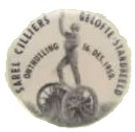
Sarel Cillers Gelofte Standbeeld 1950
On 16 December 1950, this monument was unveiled in front of the Dutch Reformed Mother Church in Kroonstad. Sarel Cilliers was a Voortrekker leader and a preacher.
Soutpansberg Eeufees 1948
The centenary was held at Schoemansdal, a town in the old Northern Transvaal that was founded by Voortrekkers in 1848.

Van Riebeeck Tercentenary 1952
The 1952 Van Riebeeck Tercentenary Festival was a massive, government-sponsored event held from March to April in Cape Town. It marked 300 years since Jan van Riebeeck’s arrival at the Cape in 1652.

Voortrekker Monument Inauguration 1949
The Voortrekker Monument was built between 1937 and 1949. It was erected to commemorate the Great Trek of the nineteenth century. It was officially inaugurated on 16 December 1949.

Klerksdorp Vroue-Monument 1920
The Klerksdorp Vrouemonument (Women's Monument) commemorates the local women and children who died in the Klerksdorp British concentration camp during the Anglo-Boer War.

Union of SA 1960
In 1960, the Union of South Africa marked its 50th anniversary (1910–1960).

Sport
Theme
Comments
Example
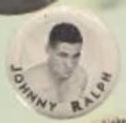
Johnny Ralph
Johnny Ralph (1925–1993) was a South African heavyweight boxer from Bloemfontein. Competing from 1946 to 1949, he held the South African Heavyweight title.
Springbok Rugby Tour 1937
The 1937 Springbok team remains the only Springbok team ever to have won a series in New Zealand and contained legendary players such as Danie Craven and Boy Louw.

Springbok Rugby Tour 1956
The 1956 Springbok tour of Australia and New Zealand was led by Captain Basie Vivier and coached by Danie Craven.

Springbok Tour 1956 Players
The Springboks were all depicted on badges made by Pin-Up, Box 5209, Johannesburg. The picture right is of the captain, Basie Vivier (not Viviers).

Willie Liebenberg
Willie Liebenberg was a legendary South African professional wrestler and promoter active from the 1940s through the 1960s. He was the South African Heavyweight Champion in 1950.

Other
Bloemfontein
We believe the person depicted is either the Prince of Wales, later King Edward VIII (visited Bloemfontein in May 1925) or Prince George, Duke of Kent (visited Bloemfontein in February 1934

Eendragt Maakt Magt
(Dutch spelling)
Eendragt Maakt Magt was the official motto of the South African Republic (ZAR) and features prominently on its former coat of arms.

Eendrag Maak Mag (Afrikaans spelling)
"Union is Strength" (translated from the Latin Ex Unitate Vires) was adopted as the motto for the Union of South Africa in 1910. Interestingly, the current South African motto translates to "Unity in Diversity”.

Helpmekaar 1917
These pins were issued to people who contributed to the "Helpmekaar" fund for paying the court fines of rebels from the 1914/15 rebellion (who opposed South Africa entering the First World War against Germany). There are at least three known colours of these pins: blue, green, and orange.

Johannesburg WWI Exemption Pin
Apparently worn by persons who were exempted from WWI active service and to avoid receiving a white feather (given to “cowards”) from citizens.

Nasionale Party Jeugbond Kaapland
The National Party established the Nasionale Jeugbond ('National Youth League') in 1938. The Cape Province (Kaapland) branch was established in 1944.

Orange Free State
Probably dating from the Anglo-Boer War period. As the English spelling is used it was probably made in the USA.

Vierkleur
The Vierkleur (Afrikaans for "Four-Colour") was the national flag of the Zuid-Afrikaansche Republiek (ZAR), also known as the Transvaal Republic, from 1858 to 1902.

Comments
In general, early South African tin badges (up to the 1950s) are not difficult to date, as the date is usually depicted on them, but there are exceptions. Take, for example, the undated "Vierkleur" badge: At first glance, one would think that it dates from the period of the Zuid-Afrikaansche Republiek (up to 1902), of which it was the official flag. However, this is impossible, as the name of the manufacturer is shown on the edge, being "J.J. Fouche Volksrust," who only started making button badges in the 1930s.
From the late 1940s, his buttons indicate his new address as Malherbestraat 35, Pretoria. This actually helps us to place an approximate date on the undated "Nasionale Heldedag" badge that carries his new address in Pretoria. (Fouche died in Pretoria in 1958).
"Tinnies" are very collectable items, as they are generally cheap, although some of them are very rare and seldom seen or offered for sale. They offer a wide range of collecting themes and are easily mounted and framed for exhibition purposes. Although they are inexpensively made, they are usually found in good condition, and especially the colourized ones are truly little works of art that serve as portable time capsules and nostalgia of times gone by.
Note from the author: This paper must be seen as work in progress, and we ask readers to send us pictures of tin badges from the period covered (1890s to the 1950s) that are not depicted in this paper. The author would also like to thank two collectors, Werner Lamprecht from Pretoria and Anthony Govender from Durban, for the pictures from their vast collections that they made available to us.