
Under the distinguished patronage of Alderman Geordin Hill-Lewis, Mayor of the City of Cape Town
In Search of a Unique South African Commemorative Medal
Pierre H. Nortje (May 2026)
Three years before the outbreak of the Second Anglo-Boer War, a Pretoria businessman by the name of John Percy Hess did something that no one before him had ever done in South Africa: he imported the first motorcar - the so-called "horseless carriage" - to be seen in our country.
The car was ordered from Benz & Co. of Mannheim, Germany, and shipped on the S.S. Herzog to Port Elizabeth, where it arrived in December 1896. It was then transported by rail to Pretoria. Interestingly enough, it seems that there is some confusion as to the correct name of the car - some sources refer to it as a Benz Velo, while others call it a Benz Voiturette. It would seem that Benz Velo is correct - the term "Voiturette" (French for "little car") was often used generically at the time to describe small, light cars.
On 4 January 1897, Hess and his business partner, A.E. Reno, exhibited the car at Berea Park in Pretoria, for which spectators had to pay an entrance fee of two shillings and six pence. Distinguished guests were also invited, including President Paul Kruger and the state secretary W.J. Leyds. The latter accepted a ride in the car, but when the president was invited, he responded, "No, thank you; a dog might bark, and the car might buck and throw me out."

A couple of days later, the car was also shown to spectators at the Wanderers in Johannesburg after which it was sold to Mr. A. H. Jacob (or Jacobs), a Pritchard Street coffee merchant. The car could be viewed at his premises by buying a pound of coffee. Sadly, it was destroyed a couple of years later in a warehouse fire, reportedly at Jacob’s premises.
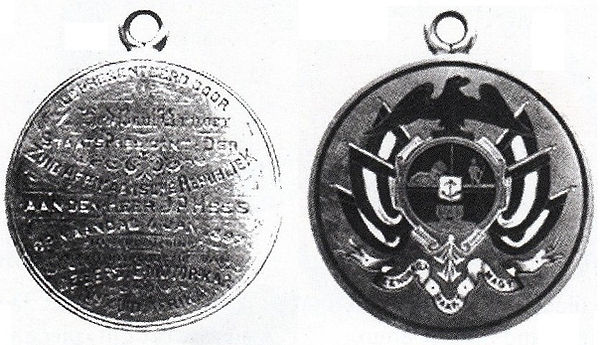
President Kruger was apparently very impressed by John Percy Hess’s efforts to import the car and exhibit it in the Transvaal, as a gold medal was struck in commemoration of its first exhibition on 4 January 1897, and presented to Hess. According to Hern’s Handbook on the Medallions of the ZAR and the Anglo Boer War, the medal was made by a Pretoria jeweller, L. Lionel Goldsmid. Hess apparently had to pay for the gold while the State paid for the manufacture. A black and white picture of the medal is provided in Hern’s Handbook, but the wording (in Dutch) is not very clear.
According to an article by Arnold Kretzmar in Pretoria News (15 February 1984) the wording translated into English reads "Presented by His Honour Paul Kruger, President of the Transvaal Republic to Mr. J.P. Hess on Monday the 4th January 1897, in honour of his having introduced the first motor in South Africa."
Not many medals commemorating cars and car companies were struck in South Africa throughout the years. Prof. Michael Laidlaw's website lists only a handful - here are three examples...
The medal at the bottom left commemorates 50 years of the Ford Motor Company in South Africa, 1923-1953. The medal in the center below commemorates the 1 millionth vehicle manufactured by General Motors in 1972. According to Prof. Laidlaw, General Motors South Africa was formed in 1913 and initially imported and distributed Chevrolet vehicles. Manufacturing of all of GM's brands commenced in 1926.
The medal on the bottom right relates to Mercedes-Benz's "Seventy Years of Motorization in South Africa." Prof. Laidlaw notes that this medal commemorates three separate events: (1) The sale of the first Benz Velo to South Africa in 1896, (2) a trip in a Benz Comfortable bringing a message of goodwill to President Kruger at his home in 1899, and (3) a similar trip by a Benz Comfortable on 27 May 1966, bringing congratulations to the State President C.R. "Blackie" Swart at his official residence on the fifth anniversary of the Republic.

These medals are generally not scarce (except for the issues struck also in gold) and can be bought for a modest sum. However, the gold medal presented to John Percy Hess by President Kruger in 1897 is unique, and its actual whereabouts are not currently known. For some reason, it is not listed on Laidlaw's website, and actually very little about it is known, i.e., where did Brian Hern source the black-and-white pictures of the medal?
We know that many pictures in his handbook originated from the collection of the late Henk Loots. His ZAR commemorative medals were sold on 4 November 2022 in postal auction 73 held by City Coins in Cape Town. We scanned the catalogue, but the Hess medal was not in the Loots collection. So where is it?
We contacted Adrian Jordi, a former Vice President of the Western Cape Numismatic Society in this regard. Adrian pointed us in the right direction - the catalogue entitled "Commemorative Medals of the Z.A.R." compiled in 1958 by Anna H. Smith, the Curator then of the Africana Museum in Johannesburg. Unfortunately, the catalogue does not provide any pictures but does give us very important information that we were not previously aware of.
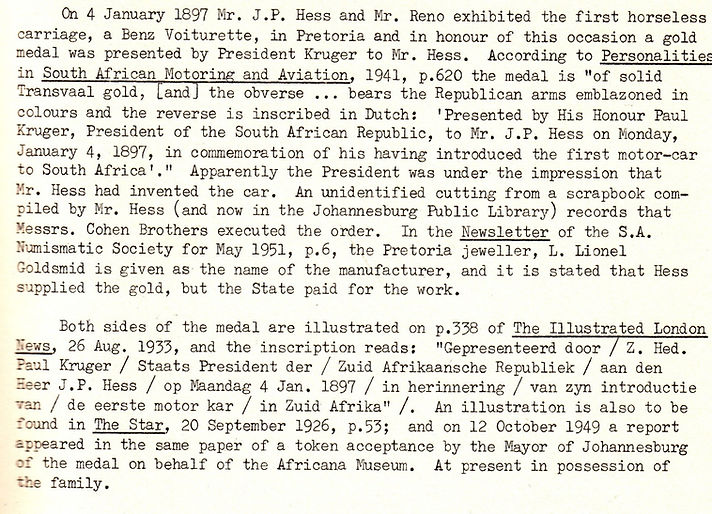
(Our comment: The Newsletter of the SA Numismatic Society of May 1951 notes that the Pretoria jeweller, L. Lionel Goldsmid received the order through "the influence of Tjaart Kruger, with whom he was very friendly." Tjaart Andries Petrus Kruger, born 9 December 1874, was the youngest son of President Kruger.)
The webmaster of the Western Cape Numismatic Society, Derick Rabe, was able to source the photo that was featured in the Illustrated London News of 26 August 1933 that Anna H. Smith mentioned. Although the picture is also in black and white, the wording on the reverse is much clearer than the one in Hern’s Handbook.

What we could learn from Smith's comments is that it seems the medal was at some stage in the collection of the Africana Museum in Johannesburg , but by 1958 it was (back) in possession of the Hess family. Our research shows that J. P. Hess (1858-1917) and his wife, Caroline Georgina (née Duthie, born 20 Oct 1867), had two children: George Rex Duthie Hess (born 1897) and Gwynneth Lina Hess (born 1899), who was later married to Donald Victor Latham.
We speculate that JP would have left the medal to his son, but as he (the son) died in 1957, a year before Smith's catalogue was compiled, the medal was probably in his wife's possession in 1958. She was Ada Naylore Hess (1902-1982). Very little about her is known, other than that she was named in the Queen's Birthday Honours of 1952 for "services to the British Red Cross Society in Nyasaland.” The family probably lived for some time in Nyasaland, present-day Malawi in East Africa. The couple is buried in Knysna, but we could not determine if they had any children.

Postscript: - During our research for this paper we stumbled upon two unrelated pieces of information about the Hess family that we wish to share with our readers.
It would seem that John Percy Hess was a captain in the service of the British Government's Intelligence Department in Port Elizabeth during the First Anglo-Boer War (1880- 1881). If President Kruger was aware of this, we very much doubt that he would have presented the gold medal to Hess in 1897.
J.P. Hess's wife, Caroline Georgina (née Duthie), was a descendant of George Rex (1765-1839), a British-born entrepreneur who spent most of his adult life in the Cape Colony. He founded the town of Knysna. It has often been stated, and was firmly believed by many of his descendants, that George Rex was the son of King George III of Great Britain. The family believed that he had been banished to the Cape, granted large tracts of land there, and was forbidden to marry. J.P. Hess’s son, George Rex Duthie Hess, was named after him.