
Under the distinguished patronage of Alderman Geordin Hill-Lewis, Mayor of the City of Cape Town
The Marsh & Sons Half Penny Token of Cape Town
Pierre H. Nortje (June 2026)
On their website, Iziko Museums of South Africa published some historical dates for events that happened in Cape Town since 1850. For the year 1869 they say “The steamship the Great Eastern arrived in Table Bay. A token penny was issued by local firm Marsh & Sons to mark the event.”
The Marsh & Sons Half Penny is a well-known old South African token, but the author was unaware that it was associated with a specific ship so decided to take a closer look at this issue.

Source: Numista
In 1945, one of the first publications by the old South African Numismatic Society was entitled “Notes from our Scrapbook” in which “Senior” (a pseudonym for A.S. Rogers) wrote an article on old South African tokens. He described the ship depicted on the token as “a strange craft” … “the like of which cannot have been seen in Table Bay for many a long year. She is a paddle-wheel steamer with three tall masts. She is evidently of the type which ploughed the seas in the middle of the last century, when sail, almost as much as steam, was the power relied on for propulsion. This type was probably old fashioned when the coin was struck sometime in the seventies”.
Rogers speculates that it may have represented some particular vessel engaged in the South African trade, which was a familiar sight in Cape Town in the eighteen seventies. He says that it may even have been intended for the Enterprise, the first steamship to visit Table Bay. In 1825, it made the voyage from England to the Cape in 55 days.
Rogers makes the mistake of assuming that the particular type of ship appearing on this Cape Town token has appeared on no other, so he believed the design was an exclusive one. In fact, the same ship was depicted on an Australian (Tasmanian) Half Penny Token. It is evident that the surnames on the South African and Australian tokens are also the same.

Source: Victoria Museum, Australia
The Victoria Museum in Australia states that the token was minted by an unknown British Mint and dates it to circa 1855. The two Marsh brothers, Henry James and Samuel Charles entered into a partnership in 1853 but the latter died the following year. In 1867 the firm was known as H.J. Marsh and Co.
However, we found a philatelic reference (Millennium Philatelic Auctions of 10 November 2023) to a Tasmanian stamp described as “-: 1d Carmine Serrated Perf 19 fiscally used with '1/7/68' pen cancel, also with albino embossing of double oval 'H.J. MARSH & BRO./IRONMONGERS/HOBART TOWN' Stanley Gibbons number 118.”
The date 1/7/1868 shows that the name H.J. Marsh and Brothers was then still in use, so the Half Penny could also date from the late 1860s in our view.
In a talk to the London Numismatic Club given by John Roberts-Lewis entitled “Nineteenth Century South African Tokens” he mentions that despite a strong assumption that branches of the same Marsh family are involved in the two tokens, no family history has been found, the only connection being the similar reverse die.
We have found a third token also depicting the same ship, being this Prince Edward Island issue of about 1858.

Source: Heritage Auctions.
The words “To Facilitate Trade” are shown on both the South African and Australian tokens. It was also used on tokens of Canada in the 1800s as shown below (note a ship is also depicted). The words refer to a means for businesses to overcome shortages of official small change in those days.

Source: Imaginaire
In the South African Numismatic Society article by A.S. Rogers, written in 1945, he mentions that the ship depicted on the token could be the Enterprise, which visited Cape Town in 1825, while Iziko Museums believes it to be the Great Eastern, which arrived in Table Bay in 1869. As a matter of interest, in his Eight Bells at Salamander (1984:155) Lawrence G. Green writes that eight thousand people paid a shilling each to visit the Great Eastern as she lay in Table Bay.
Did any of these ships also visit Australia?
The Great Eastern never did (https://docs.iza.org/dp17926.pdf), and with its six masts, it hardly looks like the three-master depicted on the token. The Enterprise also never visited Australia and looks completely different, with the paddle wheel at the rear (not the side) of the ship.
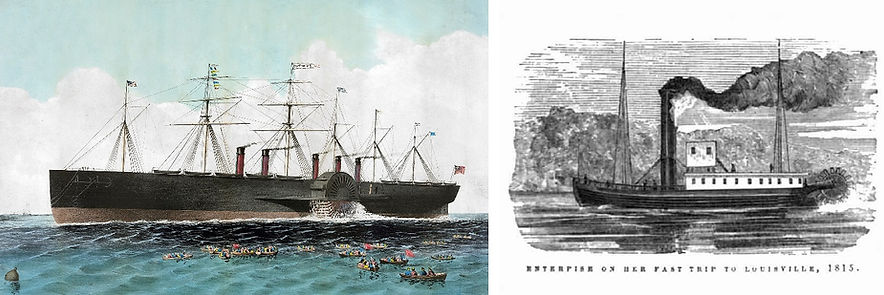
The Great Eastern (left) and the Enterprise (right) Source: Wikipedia
It would seem that A.S. Rogers had some of his other facts also wrong.
He wrote “Marsh & Sons were the agents for a certain brand of pills and another of pens, both of which had a big sale. In those ‘“good old days” money was not as plentiful as it is today, so prices were cut very fine. The retail prices of both the pills and the pens necessitated the use of halfpennies. As the local shortage of coins of the realm of this denomination was acute, these tokens were ordered from England to meet the deficiency …”
From what we could ascertain is that Marsh and Sons were actually (like the Marsh brothers from Australia) ironmongers. In Street’s Indian and Colonial Mercantile Directory for the year 1869, Marsh & Sons of 2 Burg Street Cape Town are listed under three categories as (a) Merchants, (b) Hardware and Ironmongers, and (c) Brass and Iron-founders and Ironmongers. According to Wayne Dooling (2008:175), a Tygerberg farmer by the name of Johannes Uys purchased four threshing machines and a straw binder for £600 from the firm of Marsh & Sons in 1891.

The Corner of Strand and Burg Streets 1862, a watercolour by T.W. Bowler. The name Marsh & Sons Importers can be seen above the entrance in Burg Street.
The company is named as far back as 1847 in the Cape Almanac and in the 1886 edition, the owner’s name is given as William. Our research shows that William Marsh was born in 1822 in Walsall in Staffordshire, moved to the Cape Colony with his wife, Frances, and founded a hardware firm in Cape Town that became extremely successful.
Their only son, Thomas Edward was born in Cape Town in 1853. After matriculating from the South African College, Edward worked in his father’s business from 1872 to 1878 to help him cope with the increased workload, much of which resulted from the diamond diggings in Kimberley. In 1879 Edward responded to the call of the ministry to which he would devote his life to for the rest of his days. (Kalk Bay Historical Association, Bulletin No. 20, March 2016).
It is interesting to note that in 1847, before Edward was born, the company was already called Marsh & Sons. However, this was frequently adopted by business owners of the period to convey a sense of generational legacy, tradition, and trustworthiness, rather than being an accurate description of the current owners.

Picture Source: History of the Wesleyan Methodist Church of South Africa (1906:84 & 85)
William Marsh died on the 2nd of May, 1901. In his will, he left £200,000 for the erection and maintenance of homes for orphaned and destitute children. The institution still operates today as Marsh Memorial Homes, a child and youth care center in Cape Town.
His son Edward inherited half of his vast estate, and when he died in 1935, he bequeathed his entire estate to the Bible Institute of South Africa of which he was a founding member.
Post Script: We have written to Iziko Museums enquiring about the source for their assumption that the Marsh & Sons token was issued to commemorate the arrival of the Great Eastern in Table Bay in 1869. No response was received.