
Under the distinguished patronage of Alderman Geordin Hill-Lewis, Mayor of the City of Cape Town
The King Dinuzulu Medal of 1885
Pierre H. Nortje (August 2026)

Photo credit: Coinweek / Stack’s Bowers
Introduction
Two medals are recorded that were issued by Zulu Kings during the 1870s and 1880s – the first being presented by King Cetshwayo kaMpande, who was King from 1872 to 1879. It is believed that this medal was given to visitors by the King during his exile in Cape Town, where he was imprisoned by the British authorities after the Zulu War of 1879.

Source: ianknightzulugallery.com
The second medal’s history is much more obscure, and very little about it is known. According to its reverse wording, it was awarded by King Dinuzulu (the son of King Cetshwayo) at Emnyati in northern Natal in 1885.
Why and to whom it was presented seems to have mystified numismatists and military historians for many years, but the author believes that the mystery may have been solved, at least partially.
The medal
The medal is made of bronze and is 45 mm in diameter. The obverse shows a shield within a laurel and palm wreath. The shield is divided into three parts: the upper part shows a Secretary bird holding a snake in its beak, in the middle are eight pierced slats of a Zulu shield, and at the bottom is a crocodile.
The reverse, in Zulu, reads in the band at the top “DINIZULU INKOS KA ILIZWE AMAZULU” (Dinizulu, King of the country of the Zulu) and below: “EMNYATI 1885.” In the centre, "UKU / (space for recipient's name) / NGOKUBA FANELA (to/because deserving).
The name of the King is wrongly spelled "Dinizulu" and not "Dinuzulu."
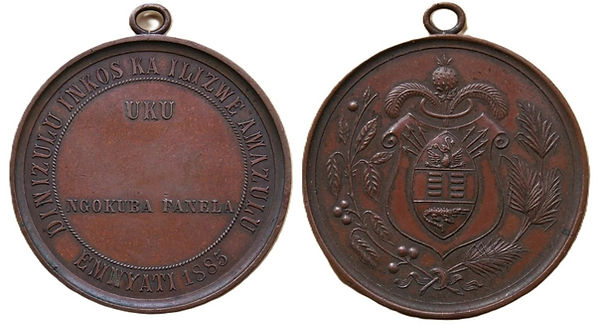
Source: iknight.substack.com
King Dinuzulu
Dinuzulu, the son of King Cetshwayo, was born circa 1868. In 1884, he succeeded his father, who was the last king of the Zulu nation to be officially recognised as such by the British.
After the Anglo-Zulu War in 1879, the British divided Zululand into 13 chiefdoms, and a turbulent period followed, resulting in civil warfare among the Zulus. A Zulu chief named Zibhebhu kaMaphitha Zulu (also called Usibepu/Ziphewu) attempted to create his own independent kingdom, and when King Cetshwayo died in 1884, he vied for the royal succession with Dinuzulu.
With the assistance of a local Boer force under General Louis Botha (who would later become the first Prime Minister of the Union of South Africa), Dinuzulu defeated Zibhebhu at the Battle of Ghost Mountain, also known as the Battle of Tshaneni. However, this was not the end of internal strife among the Zulus and opposition against British rule. King Dinuzulu was captured in 1890 and imprisoned on the island of St. Helena.
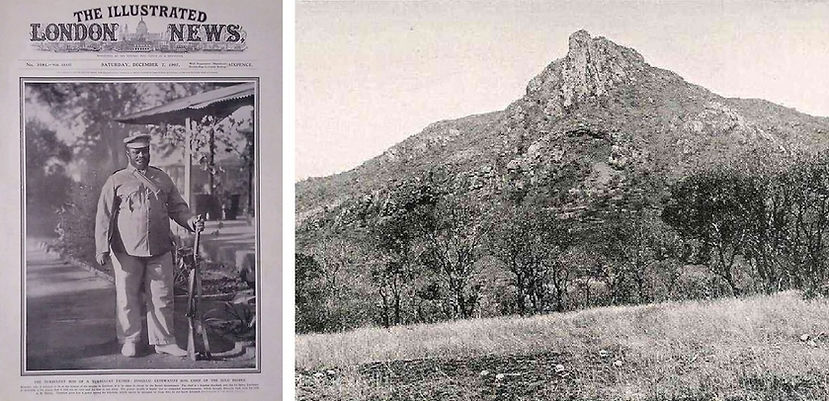
Picture left of King Dinuzulu from The Illustrated London News of 7 December 1907.
Picture right of Ghost Mountain (Source battlefieldsroute.co.za).
After his return to Natal, he was suspected of planning a rebellion against the colonial rulers and was imprisoned again. After two years in jail, his old friend General Louis Botha ordered his release, and he was transported to the farm Uitkyk in the Transvaal, where he died in 1913.
Theories about the King Dinuzulu Medal.
In a chapter entitled "Commemorative Medals," written by L.J. de Wet in Africana Curiosities (edited by Anna H. Smith and published in 1973), the author described some medals in the collection of the then-called Africana Museum in Johannesburg. One of the medals is the Dinuzulu medal of 1885. Mrs. de Wet writes that it is still a puzzle in spite of efforts to discover its history. She says that in a biography on Dinuzulu written by C.T. Bins in 1968, no mention of the medal is made, but it does refer to an event that happened in 1885 that might relate to it.
“This was the so-called treaty, not recognised by the British Government, between a German firm represented by E. Nagel and Dinuzulu in 1885. The medal seems to have been awarded by Dinizulu (sic) for services rendered to him.”
Our research shows that Nagel entered into a treaty with the King to bring German settlers to Natal "... to prevent the Boers in Zululand from taking more than they have a right to do..." However, Nagel's request to the Foreign Office was turned down in January 1886, so no concrete services by him were delivered to the King to warrant a medal.
(It seems that Emil Nagel had an obsession with creating a German colony in South Africa, as in June 1885, he concluded agreements with the Pondoland chiefs, the brothers Umhlangaso and Umquikela, regarding a land concession for a land and colonisation company. However, nothing came from this, as was the case with his treaty with the Zulu King Dinuzulu.)
A second theory for why the medal was presented by the King is found in a well-written blog article by Ian Knight (18 November 2024) entitled "The Other Zulu War Medals: Two Curiosities from the Conquest of Zululand.” Knight speculates that the medal commemorates a meeting that took place at the foot of the Nyathi hills in north-western Zululand, close to the Transvaal border, on 21 May 1884 ("… the error in the year presumably reflecting the fact that the medal was struck after the event").
He writes, “The choice of location for the meeting reflected an earlier phase in the ongoing Zulu struggle; the Nyathi hills lie on the opposite side of a valley to the Hlobane mountain, scene of a fierce battle with the British in 1879. Some 350 Boers from the Wakkerstroom and Utrecht districts of the Transvaal, who had responded to Dinuzulu’s request for aid, gathered to watch Dinuzulu crowned King of the Zulus before a crowd of about 9000 of his own supporters”.

Battle of Tshaneni or of Ghost Mountain - Zulu Civil War.
Picture source: History of All Southern African Tribes
He says that the medal was probably struck with the intention of awarding it to those Boers who had taken part in the fighting but concedes that no examples have so far come to light with the recipient's name engraved on them.
A similar view is expressed by Jeremy Bostwick, a Senior Numismatist and Cataloguer at Stack's Bowers, in an article in CoinWeek (April 22, 2021). He says that the medal was clearly meant to be given to those who had faithfully served the king during his fight to avenge his father.
On his website Southafricanmedals.com, Professor Michael Laidlaw hints at the possibility that one of the recipients could have been General Louis Botha, who assisted the King during this period with a mercenary force named the Dinuzulu Volunteers.
However, our research shows that none of the above theories is correct (in the sense that they can be proved).
The King of Zululand and his Crocodile Order
In 1853, two Germans by the names of Ernst Keil and Ferdinand Stolle founded what Sylvia Palatschek (Popular Historiographies in the 19th and 20th Centuries, published in 2010) called the first successful mass-circulation German newspaper and a forerunner of all modern magazines – Die Gartenlaube.

In its 40th edition of 1887, it published an article entitled Der König des Zululandes und sein Krokodilorden (The King of Zululand and his Crocodile Order).
The article is copied here verbatim, translated from the original German. Spelling mistakes, including names of people and places, have been left unchanged.
The African traveller Augustus Einwald, who is now on his fifth expedition to the Herero country, Srambolande, Bamangwato and Zambezi and to the still unknown Central Africa, spent a long time in the Zulu country in 1885 in order to set in motion the colonisation of the Zulu by Germans. King Dinizulu, a son of the well-known Ketschwayo, willingly agreed to this and documented Einwald a stretch of land for this settlement.
The youthful, very intelligent king knew the German conditions very well and spoke with great admiration of the mighty Kaiser Wilhelm and his invincible army. Zululand is the "paradise of Africa", as the name Zulu means "children of heaven". The army of King Dinizulu is well organized, and divided into regiments and divisions. The country offers inexhaustible wealth; for example, the coast at Port Natal produces sugar, corn, oats, corn, coal, iron and gold. The great advantage of the colonisation would be that a direct communication would be made from the Bay of Saint Lucia to Angra Pequena (Author's note: Angra Pequena is a bay in modern-day Namibia where Germans founded the town of Lüderitz in 1883).
It is characteristic of King Dinizulu that he founded an order.
It bears the name Crocodile Order, is divided into two classes and is worn on the green-yellow-red ribbon. Such a first-class specimen, which is before us, is the property of Einwald and was presented to him personally by Dinizulu. It shows a round golden shield, in the upper field of which a secretary's bird with a snake in its beak is depicted, in the lower field a crocodile, and in the middle field stripes in green and red. The border is formed by four peaks filled with green crystal and four war shields made of white enamel. In between, eight golden spears, assagais, emerge.

Order of the Crocodile of the Zulu King, 1st Class.
The Order of the Crocodile Second Class was awarded by Dinizulu to a Leipzig bookseller, at Einwald's endorsement, in consequence of a show of attention. This decoration has the shape of a medal and the size of a five-mark piece. On the obverse there is a curved shield with three fields, the upper one of which shows the secretary bird with the snake, the middle one the war shield and the lower one the crocodile. At the top, four spears emerge on each side. The crowning glory of the shield is a pineapple between two ostrich feathers, entwined by a chieftain's ring. The whole is bordered on one side by the coffee plant and on the other by the fan palm. The other side of the coin also teaches us to know the Zulu language.
The inscription here reads: "Dinizulu inkos ka ilizwe amazulu Uku Ludwig Fischer ngokuba fanela. Emnyati 1885." This means in the translation: "Dinizulu, King of Zululand, to Ludwig Fischer for merits. Emnyati (Königskraal) 1885."
These two very pretty and heraldically correct decorations of the Zulu crocodile order are probably the only ones that have come to Europe. As Augustus Einwald, who was in Leipzig last autumn, informed us, on his return from the present journey, which is fixed for 1889, King Dinizulu will accompany him with some of his most distinguished chiefs, and will also take up residence in Leipzig, whence he has received and accepted a hospitable invitation.
Our comments
As was the case with his fellow German Emil Nagel (mentioned before) Augustus Einwald also had his eyes on territories in Natal, and it seems he was more successful than Nagel.
According to Wikipedia, Einwald concluded an agreement with Adolf Lüderitz, a colonial merchant from Bremen and founder of German South West Africa, to acquire as much territory in Natal as possible for the trading house. Initially successful, he was able to secure the purchase of Santa Lucia Bay. However, it would seem that the transaction later turned sour, and the area was not placed under German protection.

Adolf Lüderitz (left) and August Einwald (right): Source: Wikipedia
It is, of course, possible that Einwald lied about his receiving the order from Dinuzulu and that it truly existed: It is not exactly clear what the magazine reporter meant when he wrote “… a first-class specimen, which is before us, is the property of Einwald”. Did he mean that he actually saw the order or that he only saw a drawing, as pictured in the magazine, presented by Einwald to him?
The second class order that was apparently awarded to Ludwig Fischer, although not pictured in the article, is correctly described based on pictures of known surviving specimens. Unfortunately, we were unable to establish why Einwald endorsed Fischer as a recipient of the medal and what the words “in consequence of a show of attention” (or attentiveness) refer to. We were unable to determine who Ludwig Fischer was.
Further information
In the late 1800s, two other European publications also mention the Zulu orders.
In 1888 and 1890/91, Meyers Konversations-Lexikon (a major German-language Encyclopedia at the time) mentions that awards were instituted by King Dinuzulu, in two classes: Rhinoceros and Crocodile Orders, as a reward for men who have rendered service to the state and the king.
Directly translated the German text reads as follows: -” The obverse of the medal shows a heraldic coat of arms, bordered on the right by a fan palm, on the left by a coffee plant; in the Zulus shield lying on it, one sees a secretary's bird with a snake in its beak at the top, eight rhomboids in the middle, and a rhinoceros at the bottom of the first class, and a crocodile in the second. Eight assagais protrude from the shield. The whole thing is crowned by a pineapple with two ostrich feathers and a chieftain's clasp”.

In 1899, the Austrian Militar-Taschen-Kalender also mentions the two Zulu orders of the Rhinoceros and the Crocodile.

In the September 1970 issue of the Journal of the Orders and Medals Society of America (JOMSA — Volume 21, Number 9, pages 16–17), Dr. K. G. Klietmann published a short article titled "The Order of the Rhinoceros and the Crocodile of Zululand (c. 1880)".
Klietmann writes that Dinuzulu’s father, King Cetshwayo, “supposedly” founded the Order of the Rhinoceros and, based on a contemporary account, it was only awarded once, to the Englishman William Grant. (According to our research, Mr. William Grant was a Durban-based trader and political adviser to the Zulu royal family during the turbulent 1880s. He acted as a key agent and counsellor to King Cetshwayo and his successor son, Dinuzulu, famously helping negotiate land concessions with Boer mercenaries that led to the creation of the Nieuwe Republiek in 1884.)
Klietmann then says that King Dinuzulu created another order, the Order of the Crocodile, in two classes. The order he describes (the 2nd class issue) also mentions Ludwig Fisher’s name inscribed on the reverse.
According to Klietmann, the King Cetshwayo Order of the Rhinoceros and the King Dinizulu Order of Crocodile are similar except that the depiction of the crocodile replaces the rhinoceros in the latter order. Nevertheless, he says that in his opinion, neither of these orders actually existed. He speculates that enterprising “order creators” may have had diplomas printed to be sold towards the end of the 19th century – possibly in Paris. He also says that it would be interesting to know if such orders were actually made and if some may still exist.
From what we could deduce from his article, was that Klietmann seems to have been unaware that examples of the Order of the Crocodile (at least the second class issue) indeed exist, and although they are very rare, they are definitely not unique. The Orders of the Rhinoceros and the Crocodile (1st class) remain a mystery and, should any examples exist, must surely be one of the rarest South African awards ever produced.