
Under the distinguished patronage of Alderman Geordin Hill-Lewis, Mayor of the City of Cape Town
The Ragama Prisoner of War Commemorative Medals
Pierre H. Nortje (October 2026)

Introduction
The Anglo-Boer War was a military conflict from 11 October 1899 to 31 May 1902 between the British Empire and the two independent Boer republics: the South African Republic (Transvaal) and the Orange Free State. During the war, the British sent Boer prisoners of war overseas because the camps in South Africa had become overcrowded and there was a significant risk that prisoners might be freed by their comrades or sympathisers.
By sending the prisoners to remote British colonies and islands such as Saint Helena, Ceylon (now Sri Lanka), Bermuda, and India, escape was rendered virtually impossible, and they were completely removed from the battlefield. Approximately 25 630 of the 28 000 prisoners were ultimately sent to these overseas destinations. There were approximately 2 000 to 2 500 foreign volunteers (and numerous expatriates already living in the republics) who fought alongside the Boer commandos, and many of those taken prisoner were sent with their Boer comrades to the overseas camps.
The British authorities sent more than 5 000 Boer prisoners of war to the island of Ceylon (now known as Sri Lanka). Three POW camps were established there, being the main camp at Diyatalawa, the Ragama camp for "irreconcilables" (some sources also refer to them as “incorrigibles”), and the hospital camp at Mount Lavinia. There were also two camps for those on parole at Uragasmanhandiya and Hambantota.
The Ragama Camp
The camp at Ragama was situated roughly 16 kilometres north of Colombo, the capital of present- day Sri Lanka. It was established as a specialised camp for dissidents, foreign volunteers, and irreconcilables who caused trouble or refused to sign an oath of allegiance to King Edward VII. It housed both Boer prisoners transferred from other locations and foreign volunteers who fought alongside the Boers. In terms of size, it was relatively small, housing only about 300 prisoners, most of whom were of Dutch origin, with the camp commandant being Captain I. Ingram. It opened in January 1901, and although the war ended on 31 May 1902, there were still prisoners kept there in September of that year.

Prisoners of war at Ragama camp, with an English guard standing to the right of the picture. Note the palm trees that will feature later in this paper
(Source: In April 1901, shortly after the POW camps were established, the photographer A.W. Andree published a series of images – ‘Life in the Boer Camp ’- documenting the first few months of the prisoners in Diyatalawa and Ragama).
Of interest to numismatists is the fact that three sets of Ragama money notes were printed, the first being issued by the military (picture below left), and the second and third series were produced by the Ceylon Ice and Cold Storage Company (picture below right) for the prisoners to use at their own store.

Source: notes.lakdiva.org.lk
The Medals
In 1958, Anna H. Smith compiled a catalogue for an exhibition of Z.A.R. commemorative medals kept in the Africana and Transvaal museums, augmented by special loans. Medal number 133 is entitled Ragama Camp, Ceylon, 1902, while medal number 134 is named Rotterdam Lloyd Ragama Camp Medal, 1902.
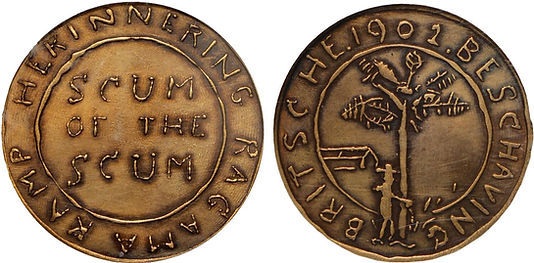
Her description of the first-mentioned is as follows: The obverse shows a Boer tied to a palm tree, with a P.O.W. hut in the background. The legend reads "Britsche. 1902. Beschaving”. The reverse reads within a circle "Scum of the Scum," with "Herinnering Ragama Kamp" around it. Smith notes that it is said the medal was struck on a Kruger Penny and that the expression "scum of the scum" was taken from an article in the Times of Ceylon, according to a note (without a source) in the Africana Museum.

Source: southafricanmedals.com
Smith also states that H.G. du Grocq, in the Tijdschrift van het Koninklijk Nederlands Genootschap voor Munt- en Penningkunde, vol. 11, 1903, p. 82-83, indicates that this medal is the work of C.F. Keyzer, a Ceylon P.O.W. and former employee of the N.Z.A.S.M. (The Netherlands-South African Railway Company). This is a spelling mistake and should be G.F. Keyzer (Gerhardus Franciscus), who is recorded as a POW by www.wendag.com, an Afrikaans website listing, inter alia, Boer prisoners of war and exiles.
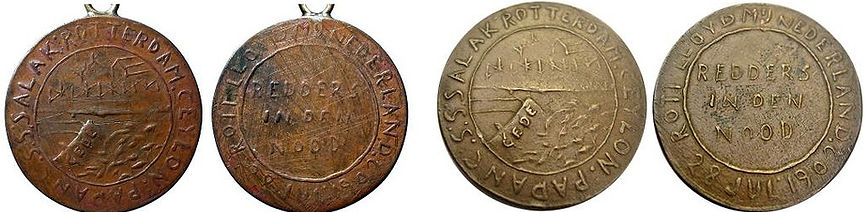
Regarding the second medal, Smith says that in the same article from 1903, H.G. du Grocq records the existence of a medal commemorating the transport of former prisoners of war from Ceylon to Rotterdam. The obverse shows the ship marked "Gede" ploughing through rough waves with Ragama Camp in the background. The legend reads "Ceylon Padang S.S. Salak Rotterdam.” On the reverse, "Redders in den Nood" and "Rott. Lloyd. Mij. Nederland 28 Jul. 1902".

Source: southafricanmedals.com
The Scum of the Scum Medal
In an article entitled “The Wartime Correspondence of Jeannot Weinberg” by David Saks that was published in the Military History Journal (Vol 12 No 1 - June 2001) the author describes the wartime correspondence of Jeannot Weinberg, a Jewish POW in Ragama Camp.
As a foreigner from Germany fighting on the Boer side, Weinberg was transferred, much against his will, from the main POW camp, Diyatalawa, to Ragama. On 31 December 1900, he wrote, “I would not mind to go if some of my friends came with and they are all Afrikanders“ (but) “the Germans, Hollanders, Irish Americans are, with a few exceptions, a most disreputable lot. They are without exaggeration the scum of the scum”. According to Prof. Michael Laidlaw on his southafricanmedals.com website, this “scum of the scum” appellation also appeared in a 'Times' of Ceylon article.

A German postcard depicting prisoners at Ragama (Source: notes.lakdiva.org.lk)
It would thus suggest that the “scum” referred to were prisoners of war at the Ragama camp. However, in his article of 1903, H.G. du Grocq has a contrary view, as he hints that the scum was the English prisoner guards. Translated from the original Dutch, he wrote …
“Tying a prisoner to a tree was a common punishment for minor breaches of discipline among the prisoners of war. The camp guards were British soldiers equipped with sticks rather than firearms. The prisoners resisted this arrangement; having been captured with arms in hand, they demanded to be guarded by a proper military force—they were not dogs to be handled with sticks!"

Prisoners in one of the sleeping huts at Ragama (Source: Zuid Afrika Huis, Amsterdam)
Notwithstanding, it would seem that the scum referred to on the medal were indeed the prisoners. Even before Jeannot Weinberg’s letter of 31 December 1900, the newspaper Nieuws van den Dag of 19 September 1900 printed a letter written by Dr J.D. Koster from the Diyatalawa Camp in Ceylon dated 22 August 1900. It was addressed to the Chairman of the Head Committee of the Netherlands Red Cross. He wrote that a certain reporter from a paper published in Colombo felt obliged to speak in insulting terms about the first transport of prisoners to arrive in Ceylon, calling them “riffraff” and “scum of the scum” of different European countries.
Regarding the medals themselves, Prof. Laidlaw notes that it was originally thought that the blanks used were skimmed ZAR pennies. However, a newspaper article in "De Locomotief" of 20 May 1903, published in Semarang, Indonesia, wrote that the coins used were filed-off Ceylon 5 cents of Queen Victoria.

Laidlaw adds that the medals' sizes are between 30.0 mm and 30.8 mm and weigh 8.0 grams. Hern (2008: 76) gives the size as 30 mm, while Smith (see above) notes that the Africana Museum specimen is 32 mm in diameter, including the mount it is set in. She notes that the medal was made in both copper and bronze. This is confusing, as the Ceylon 5 cent of Queen Victoria was only struck in copper. A specimen of the bronze medal was auctioned by Heritage Auctions on 22 May 2017. It is noted that the medal weighed 10.13 grams and measured 30.4 millimetres in diameter.
In an article by Gary Oddie entitled "Ragama POW Camp Ceylon and the Scum of the Scum" in the Token Corresponding Society Bulletin Vol. 11 No. 3 June 2014, he notes that his specimen is "darkly toned brass with traces of tinning, 30mm, plain edge, slightly thicker than an old bronze penny."
Regarding the few specimens that we could source, the average weight was 9.7 grams, with the size approximately 30mm. Specimens in bronze, copper, and one in brass are recorded. For comparison, here are the figures for three possible host coins.

Source: Numista
Except for Laidlaw's example that weighs 8 grams, none of the other examples that we could source weigh less than 9.4 grams, so we very much doubt that either English or ZAR pennies could have been used as the host planchets, as, after skimming, they would have weighed less than 9.4 grams. Then, the Ceylon 5 cent was most probably too large, weighing almost twice that of the average weight.
So the sum does not add up, and we are unsure what coins were used for the hosts. There is, of course, the chance that G.F. Keyzer used planchets that he himself manufactured. H.G. Du Grocq noted that he was employed by the N.Z.A.S.M. in Pretoria before the war as a "bankwerker" (bench worker), a craftsperson or technician in the metal industry who processes, modifies, fabricates, or assembles metal components at a workbench or with the aid of specific tools and machines. As we shall see later in this paper, some sources suggest that he may not have been in the service of the N.Z.A.S.M. in Pretoria but worked in Amsterdam as a "fijnsmid", a person who specializes in making small, intricate, and highly detailed metal objects.
According to Laidlaw, it is not known where the medals were manufactured. The possibilities are: in the camp, on the journey back to the Netherlands, or in the Netherlands. However, we now know that they were indeed manufactured in Ceylon. On the 7th of August 1902, the Leeuwarder Courant reported that a nurse by the name of (Evert) Meuleman, a member of the Dutch ambulance corps stationed in Ceylon, brought back one of the medals made by a prisoner there. Meuleman said that because the Boers were called scum, the medal maker appropriated it to an honourable title. The report, unexpectedly, states the date of the medal is 1901.
Lastly, Laidlaw mentions that, apparently, varieties exist (he is not referring to their metal content) but may be only the result of the poor strike. Some of the medals that we compared virtually confirm that varieties indeed exist - see the following pictures...

The "C's" in Scum of the Scum look completely different, while the date (below) on one coin resembles a cross between 1901 and 1902, whereas on the other medal it is clearly 1902. In an article written by Henk Loots for the ASANS publication (Vol 4), two of these medals are shown and Loots comments “There are slight differences in the reverse of the two examples illustrated e.g. in the "a" of "kamp" and the first "n" of "herinnering".

These two medals, in our opinion, could not have been struck by the same dies. This leaves the question of whether all the medals were made by 1902, or if some were later strikes, possibly at the request of ex-P.O.W.s or collectors who contacted Keyzer (or another manufacturer) at some later stage? What we do know is that the copper coloured medal with the date looking like 1901, is an original strike as can be deduced from the Meuleman newspaper report of 7th of August 1902 in the Leeuwarder Courant.
Please note that modern copies of this medal are recorded, e.g. in St James’s Auctions, sale 103 of 15 April 2025, lot 487 was explicitly described as a modern restitution of the medal, 30.5 mm, gilt, and encapsulated by SANGS with a Mint State 61 grade. The medal is pictured below.
The Rotterdam Lloyd Medal of 28 July 1902
This is an exceptionally rare medal: When Hern's Handbook on the Medallions of the ZAR and the Anglo-Boer War was published in June 2008, he was unable to source a picture of it. In November of the following year, an example was offered in City Coins Postal Auction number 59, item 318. Mention is made in the catalogue that there is the possibility that it was the first time the medal has been offered for sale.
According to Laidlaw, a medal that belonged to Burger H. H. Smorenburg, who was a member of Hollander Corps, was sold by Stephan Welz at auction on 17 November 2012. Laidlaw shows two examples on his website, one with and one without a loop – both struck in bronze (although the colours of the two medals differ significantly). Hern only mentions a copper issue. The size of the medal is 33.55 mm, and Laidlaw says it weighs 19.5 grams – more than twice the weight of the Scum of the Scum medal that he features on his website. According to H.G. du Grocq in his 1903 article, both medals were made by G.F. Keyzer in red copper.
Source: southafricanmedals.com
The medal is dated 28 July 1902, which was the date the ship left for Europe. Therefore, the medal was probably not made at Ragama, as the prisoners would have been unaware that there would be a switch in ships during their voyage back to Europe. However, the Royal Zeeland Society’s annual report for 2021 mentions correspondence with a Jan Lingen (a well-known Dutch numismatist) regarding this medal (GM2427) that was made by a liberated POW from Ragama while aboard the Dutch vessel SS Salak, during its voyage from Ceylon to Rotterdam.
The author was unable to confirm this claim, and very much doubts it, as the Salak was, at least technically, not on a voyage to Rotterdam, but to Padang. H.G. du Grocq wrote that the liberated POWs were transported from Colombo to Padang (West Sumatra) aboard the steamship Salak and from there to Rotterdam on the Gédeh (on the medal, it is spelled Gede, its correct name). Both ships belonged to the Rotterdamsche Lloyd Maatschappij (Rotterdam Lloyd), a well-known Dutch shipping company based in Rotterdam.
The pickup of the Hollanders in Ceylon was made in late July 1902, and the transfer between the ships in Padang took place on August 2, 1902. The Gede arrived in Rotterdam at the beginning of September, but some of the passengers had already disembarked in Marseille, France.

The steamships Gede (left) and Salak (middle). The picture on the right shows a card commemorating the return voyage to the Netherlands on the Gede, carrying the signatures of the ex-POWs (Source: Philately Magazine of the American Society for Netherlands Philately, Volume 46/6 - July 2022).

On the 30th of August 1902, both De Nuwe Courant and De Avontpost reported on the 76 passengers who were scheduled for the return voyage on the Gede to the Netherlands. The names of all are reported, including G.F. Keyzer and H. H. Smorenburg.
However, 9 of the 76 persons were not interned in Ceylon but at the Trichinopoly Boer POW Camp in southern India. This is important, as it means that the medal was not exclusively struck to commemorate those interned at Ragama.
In one of the newspaper reports, it is also stated that some of the 76 passengers earmarked for the voyage, those marked with an asterisk in the report, may find employment in India, and may not be passengers on the return voyage.
On 11 October 1902, the Haagsche Courant also published the names of the passengers and, for some reason, named those that were in the employ of the Zuid-Afrikaansche Spoorweg Maatschappij, but Keyzer's name was not among the seven listed. It was, however, stated that he was from Amsterdam. In the report published in De Locomotief on 20 May 1903, his occupation is named as a “fijnsmid”.
Some last thoughts
When one looks at the list of Boer Prisoners of War and Exiles on the wendag.com forum (available online), one notices that there are plenty of isonyms (surnames that have the same origin or are spelled very similarly to another).
Regarding the surname Keyzer, we also found Kaiser, Keiser, Keizer, and Keyter. Only two Keyzer names are listed, those of Gerhardus Franciscus and Lodewijk. In one of the passenger list reports that we sourced (see newspaper reference list below), a Lod(ewijk) Keizer is listed, and in our opinion, this could only be the Lodewijk Keyzer mentioned by the wendag.com forum. So, one of the two sources spelled the surname wrong.
Although both sources spelled G.F. Keyzer's surname the same, we could find no other records of the man - it is as if he vanished after the war. Even on the memorial card with the signatures of the passengers shown earlier in this paper, his name is missing.
Prof. Laidlaw notes that he was captured at Boshof on 5 April 1900 and sent as a P.O.W. to Ceylon (No. 2783), where he was interned in the Ragama camp. His age is noted as 52. What happened to him after the war? Did he stay in Amsterdam? Did he really work for the N.Z.A.S.M.? Did a picture of him survive? These are some of the questions we were unable to answer.
We invite readers who have more information on him to please contact the WCNS.
References
Andree A.W., Life in the Boer Camp (picture series) published in 1901.
Du Grocq H.G., Twee merkwaardige Boeren-penningen, published in the Tijdschrift van het Koninklijk Nederlands Genootschap voor Munt- en Penningkunde vol. 11, 1903.
Hern B., Handbook on the Medallions of the ZAR and the Anglo Boer War published in 2009.
Heunis V.R., Anglo-Boereoorlog Boerekrysgevangenekuns, 1899-1902, Doctoral Thesis, University of Pretoria, August 1919.
Kremer H., Anglo-Boer War Prisoners of War in Ceylon, published in the Philately Magazine of the American Society for Netherlands Philately, Volume 46/6 - July 2022
Koninklijk Zeeuwsch Genootschap der Wetenschappen, Jaarverslagen 2021, Archief 2022 II, section Munten en Penningen.
Laidlaw M. Items numbers 0786a and 0786b, South African Commemorative Medals, available online.
Loots H., Lesser Known Boer War Medals (1899-1902) published in Volume 4 (undated) of the Association of South African Numismatic Societies.
Numista. Numismatic website available online.
Oddie G., Ragama POW Camp Ceylon and the Scum of the Scum published in the Token Corresponding Society Bulletin Vol. 11 No. 3 June 2014.
Saks D., The Wartime Correspondence of Jeannot Weinberg published in the Military History Journal (Vol. 12 No 1 in June 2001).
Smith A.H., Africana Museum, Commemorative Medals of the ZAR published in 1958.
Ratnatunga K.U., Lacdiva, the Pearl of the Ocean, available online.
Wendag.com forum, Boere Krygsgevangenes / Bannelinge, available online.
Zuid Afrika Huis, Beelden uit het archief: Krijgsgevangenkamp Ragama III, Colombo, Ceylon. Available online.
Newspaper reports (available online on the Delpher website: a free Dutch digital library and search engine managed by the KB National Library of the Netherlands).
Arnhemsche Courant of 6 August 1902
De Avontpost of 30 August 1902
De Courant of 29 August 1902
De Locomotief of 20 May 1903
De Nieuwe Courant of 30 August 1902
Haagsche Courant of 11 October 1902
Het Nieuws van den Dag of 19 September 1900
Kleine Courant of 8 August 1902
Leeuwarder Courant of 7 August 1902